Travel/ Places/ Nature
Sunday, March 15, 2009

Monday, March 9, 2009
Egypt Travel Information and Hotel Discounts

Egypt Travel Information and Hotel Discounts
The Arab Republic of Egypt, commonly known as Egypt, romanized Misr, in Egyptian Arabic Másr, listen (help·info)), is a republic in North Africa. While most of the country is geographically located in Africa, the Sinai Peninsula east of the Suez Canal is in Asia. Alexandria Cairo Port Said
Covering an area of about 1,001,450 square kilometres (386,560 mi²), Egypt shares land borders with Libya to the west, Sudan to the south, and Israel and the Gaza Strip to the northeast and has coasts on the north and east by the Mediterranean Sea and the Red Sea, respectively.
Egypt is the fifteenth most populous country in the world. The vast majority of its 77 million population (2005) live near the banks of the Nile River (about 40,000 km² or 15,450 mi²), where the only arable agricultural land is found. Large areas of land are part of the Sahara Desert and are sparsely inhabited. About half of the Egyptian people today are urban, living in the densely populated centers of greater Cairo, the largest city in Africa, and Alexandria.
Egypt is famous for its ancient civilization and some of the world's most stunning ancient monuments, including the Giza Pyramids, the Karnak Temple and the Valley of the Kings and the Great Sphinx; the southern city of Luxor contains a particularly large number of ancient artifacts. Today, Egypt is widely regarded as the main political and cultural centre of the Arab and Middle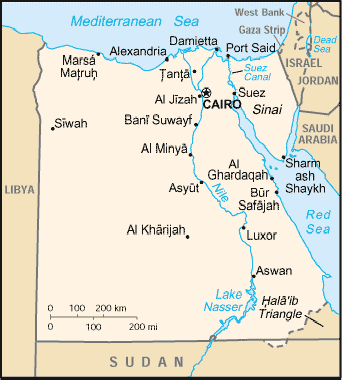
Origin and history of the name
Misr, the Arabic and official name for modern Egypt, is of Semitic origin directly cognate with the Hebrew מִצְרַיִם Mitzráyim meaning "the two straits", and possibly means "a country" or "a state." The ancient name for the country, kemet, or "black land," is derived from the fertile black soils deposited by the Nile floods, distinct from the 'red land' (deshret) of the desert. This name became keme in a later stage of Coptic. The English name "Egypt" came via the Latin word Aegyptus derived from the ancient Greek word Αίγυπτος Aiguptos (see also List of traditional Greek place names). This word may in turn be derived from the ancient Egyptian phrase ḥwt-k3-ptḥ ("Hwt ka Ptah") meaning "home of the Ka (part of the soul) of Ptah," the name of a temple of the god Ptah at Memphis. For details see the article Copt.
History
Main articles: History of Egypt and Ancient Egypt
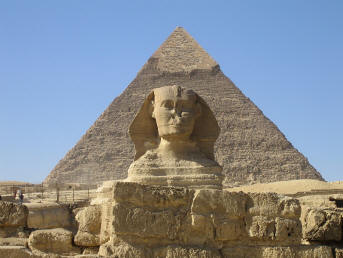
The Great Sphinx of Giza, with the Pyramid of Khafre in the background are at the heart of Egypt's thriving tourism industry.The regularity and richness of the annual Nile River flood, coupled with semi-isolation provided by deserts to the east and west, allowed for the development of one of the world's great civilizations. A unified kingdom was founded circa 3200 BC by King Narmer, and a series of dynasties ruled in Egypt for the next three millennia. The last native dynasty, known as the Thirtieth Dynasty, fell to the Persians in 341 BC who dug the predecessor of the Suez canal and connected the Red Sea to the Mediterranean. Later, Egypt fell to the Greeks, Romans, Byzantines and Persians again.
It was the Muslim Arabs who introduced Islam and the Arabic language in the seventh century to the Egyptians, who gradually adopted both. Muslim rulers nominated by the Islamic Caliphate remained in control of Egypt for the next six centuries. A local military caste, the Mamluks took control about 1250 and continued to govern even after the conquest of Egypt by the Ottoman Turks in 1517.
Following the completion of the Suez Canal in 1869, Egypt became an important world transportation hub; however, the country also fell heavily into debt. Ostensibly to protect its investments, the United Kingdom seized control of Egypt's government in 1882, but nominal allegiance to the Ottoman Empire continued until 1914.
Almost fully independent from the UK in 1922, the Egyptian Parliament drafted and implemented a new constitution in 1923 under the leadership of the popular revolutionary Saad Zaghlul. Between 1924-1936 there existed a short-lived but successful attempt to model Egypt's constitutional government after the European style of government; known as Egypt's Liberal Experiment. However, in 1952 a military coup d'état forced King Farouk I, a constitutional monarch, to abdicate in support of his son King Ahmed Fouad II.
Finally, the Egyptian Republic was declared on 18 June 1953 with General Muhammad Naguib as the first President of the Republic. After Naguib was also forced to resign in 1954 by Gamal Abdel Nasser, the real architect of the 1952 movement, the latter assumed power as President and nationalized the Suez Canal leading to the 1956 Suez Crisis. Nasser came out of the war an Arab hero, and Nasserism won widespread influence in the region though was met with mixed reactions amongst Egyptians, many of whom had previously been indifferent to Arab nationalism.
Between 1958 and 1961, Nasser undertook to form a union between Egypt and Syria known as the United Arab Republic. This attempt too was met with mixed reactions, and it was clear that many Egyptians resented finding that the name of their country, which had endured for thousands of years, was suddenly eliminated. Three years after the 1967 Six Day War, in which Egypt lost the Sinai to Israel, Nasser died and was succeeded by Anwar Sadat, who presented his takeover in terms of a Corrective Revolution. Sadat switched Egypt's Cold War allegiance from the Soviet Union to the United States, expelling Soviet advisors in 1972, and launched the Infitah economic reform, while violently clamping down on religious and secular opposition alike. Egypt's name was also restored.
In 1973, Egypt, along with Syria, launched a surprise attack on Israel in the October War (known also as the Yom Kippur War), which, despite not being a complete military success, was by most accounts a political victory. Both the United States and the USSR intervened, and a cease-fire was reached between Egypt and Israel. In 1979, Sadat made peace with Israel in exchange for the Sinai, a move that sparked enormous controversy in the Arab world and led to Egypt's expulsion from the Arab League (it was readmitted in 1989). Sadat was murdered by a religious fundamentalist in 1981, and succeeded by Hosni Mubarak.
Economy
Main article: Economy of Egypt
Egyptian countryside, south of Cairo.Egypt's economy depends mainly on agriculture, media, petroleum exports, and tourism; there are also more than 5 million Egyptians working abroad, mainly in Saudi Arabia, the Gulf area like UAE, and Europe. The United States as well has a large population of Egyptian immigrants.
The completion of the Aswan High Dam in 1971 and the resultant Lake Nasser have altered the time-honored place of the Nile River in the agriculture and ecology of Egypt. A rapidly-growing population (the largest in the Arab world), limited arable land, and dependence on the Nile all continue to overtax resources and stress the economy.
The government has struggled to prepare the economy for the new millennium through economic reform and massive investments in communications and physical infrastructure, much financed from U.S. foreign aid (since 1979, an average of $2.2 billion per year). Egypt is the third-largest recipient of such funds from the United States following the Iraq war. Economic conditions are starting to improve considerably after a period of stagnation due to the adoption of more liberal economic policies by the government, as well as increased revenues from tourism and a booming stock market. In its annual report, the IMF has rated Egypt as one of the top countries in the world undertaking economic
Demographics
Main article: Demographics of Egypt
Egypt is the second most populous country in Africa, at about 77,500,000 people. Nearly all the population is concentrated along the banks of the Nile, notably Alexandria and Cairo, and in the Delta and near the Suez Canal. Approximately 94% of the population adheres to Islam and most of the remainder to Christianity (primarily the Coptic Orthodox denomination).
The Egyptians are a fairly homogeneous people. North African and Eastern Mediterranean influences are more predominant in the north, while the south which bears the same influences is also home to people who are related to Nubians and Africans further southeast such as Ethiopians. The bulk of modern Egyptian society still maintains a homogenous genetic tie to ancient Egyptian society, which has always been rural and quite populous compared to neighboring countries. The Egyptian people have spoken only languages from the Afro-Asiatic family (previously known as Hamito-Semitic) throughout their history starting with Old Egyptian to modern Egyptian Arabic.
Ethnic minorities include a small number of Bedouin Arab nomads in the Sinai and eastern and western deserts, as well as some Nubians clustered along the Nile in Upper (southern) Egypt who are estimated to be about 0.8% of the population. Egypt also hosts some 90,000 refugees and asylum seekers, made up mostly of 70,000 Palestinian refugees and 20,000 Sudanese refugees. The once-vibrant Jewish community in Egypt has virtually disappeared, with only a small number remaining in Egypt and those who visit on religious occasions. Several important Jewish archeological and historical sites also remain.
Geography
Main article: Geography of Egypt
A great part of Egypt's landmass is desert.Egypt is bordered by Libya on the west, Sudan on the south, and on Israel on the northeast. Egypt's important role in geopolitics stems from its strategic position: a transcontinental nation, it possesses a land bridge (the Isthmus of Suez) between Africa and Asia, which in turn is traversed by a navigable waterway (the Suez Canal) that connects the Mediterranean Sea with the Indian Ocean via the Red Sea.
Towns and cities include Alexandria, one of the great ancient cities, Aswan, Asyut, Cairo, the modern Egyptian capital, El-Mahalla El-Kubra, Giza, the site of the Pyramid of Khufu, Hurghada, Luxor, Kom Ombo, Port Safaga, Port Said, Sharm el Sheikh, Shubra-El-Khema, Suez, where the Suez Canal is located, Zagazig, and Al-Minya.
Deserts: Egypt includes parts of the Sahara Desert and of the Libyan Desert. These deserts were referred to as the "red land" in ancient Egypt, and they protected the Kingdom of the Pharaohs from harm.
Oases include: Bahariya Oasis, Dakhleh Oasis, Farafra Oasis, Kharga Oasis, Siwa Oasis. An oasis is a fertile or green area in the midst of a desert.
Egypt – Not Just A Vacation
Egypt – Not Just A Vacation, It’s The Trip Of A Lifetime

Argument aside, there is a difference between a vacation and the trip of a lifetime. According to the Merriam Webster’s Collegiate Dictionary a vacation is defined as "a period spent away from home or business in travel or recreation." A trip is simply defined "to make a journey."
In my opinion, there is no greater journey that could be made than a trip to Egypt.
If you asked me just a few years ago what my thoughts of Egypt were, I would have told you, The Pyramids, King Tut and The Nile River. That was the extent of my "knowledge" on Egypt. Then something special happened just two years ago – as I was reading a brochure about an African Safari; it mentioned a side trip to Egypt. Next thing I knew, I was totally enthralled with the thought of visiting Egypt. It consumed my every thought and just a few short weeks later I made the decision to go. I invited my Parents and before I knew it I was on the phone making reservations with Egypt Tours & Travel for our wonderful journey!
My sudden enthusiasm for Egypt may have sounded bizarre and it quite possibly could have been, but as it is often said "things tend to happen for a reason." Just by reading that brochure on Africa, I was meant to fall in love with Egypt and everything the country has to offer!
From the time I made our reservations I was very eager to learn everything I could about Egypt. I watched every show that was  on the television, I purchased videos, and read just about every conceivable book I could about this amazing place. I made the decision to be an educated visitor and was willing to learn as much as possible before the trip. This trip was going to be the trip of a lifetime! Why all the preparation? I felt that building a simple foundation on everything concerning Egypt would make the trip that much more enjoyable and the knowledge I would obtain while sightseeing would be increased.
How did I prepare? Simple, I sat at my computer on this very web site and I began filling a notebook full of information on all of the possible sites that I felt my Parents and I could see while we were there. I included much of the information you will see on our web site along with maps, pictures and other notes that I jotted down from my research. Our web site has so much information that you could not possibly go wrong by starting here.
Please understand, I am not suggesting that you do this much research but I would ask you to gather as much information as you possibly could because your trip of a lifetime will be that much more enjoyable!
As you prepare for your trip to Egypt, there are basically five distinct categories you should learn about:

Why should you learn about the Egyptian people? In all honesty, it is because they are amazing. There is a simple beauty in the people that words can not prop erly express. You see it in their smiles, in the clothing they wear, and in their homes and businesses. The Egyptian’s that we were so happy to come in contact with were incredibly kind, very caring and genuinely concerned for us. I have made friends that will last a lifetime.
One word of advice, it is very important that you respect the Egyptian people’s religious and social beliefs while you are visiting. What occurs in other countries throughout the world may or may not occur in Egypt.
When preparing for your journey, please research everything you can on travel. There are several key areas that should be considered. They are air travel, automobiles, train, and cruise ships.
Traveling through Egypt can be accomplished using any of the ways mentioned above but understand that certain areas of Egypt are easier or more accessible than other areas. Depending on your time constraints for example, driving to Alexandria from Cairo is very straightforward and only 3 hours away. But Luxor is easier to reach if you fly or take a train.
There are many very good travel books that will be useful in your planning. This web site alone touches on all of these areas and should be used to make planning your trip that much easier! REMEMBER - you may also post your questions on our Web Board where our loyal readers will be happy to give you a hand. You may also make a new friend!

There are several airlines with flights to Egypt throughout the world. One of the most popular in the United States and within Egypt is EgyptAir. EgyptAir flights are comfortable and the flight staff is very kind and courteous. You may obtain information on this airline by clicking EgyptAir or by going to our web site for additional information.
Driving a car in Egypt is so very different than in the USA for example. The famous motto, "If you can drive in New York City, you can drive anywhere!" no longer holds the same meaning to my Parents or me. Our new motto is "If you can drive in Cairo, driving in New York City will be a breeze!" Cairo has one of the world’s largest populations and it seems that there are that many cars on the road! Not to mention the donkeys and oxen that you will see walking along side the road! Driving in Egypt generally takes on a special significance to visitors after their first trip. When I returned home to New Jersey, I could still hear the horns honking and picture the headlights flashing in my sleep. (Throughout Egypt, drivers talk to each other by using their horns and headlights to pass each other.)
Traveling by train in Egypt is exciting, especially on the sleeper trains. Go to sleep in one amazing city and wake up in another. It is an alternative to flying although the costs may be similar depending on the situation. Information concerning train travel and the location of train stations can be found on our web site by clicking here.
No matter what anyone could say, there is nothing better in the world than cruising down The Nile! The beauty you will see along the way is breathtaking and truly unforgettable. There are over 70 cruise ships that go up and down The Nile so there are differences from one ship to the next but in all honesty, the ship only adds a small amount to the overall cruise.
You will find that the majority of accommodations in Egypt are very nice. Wherever you stay,  hospitality is one thing that you will definitely find in all of the hotels throughout the country. There are hotels available for every price range. Some hotels are small and quaint while others are large and elegant. Every good travel book will have this information.
As an aside, my first night in Egypt was spent at The Mena House Oberoi Hotel looking directly at the Great Pyramid! Being able to wake up every morning and look at The Great Pyramid was truly amazing! Whatever hotel you do stay in while visiting Egypt will offer something unique but you can be assured that the hospitality will be second to none.
Take your time as you drive, fly or cruise throughout the country. Take time to notice all of the small things, the beauty of the desert with its’ colorful and ever-changing sands, the tranquility of the water that makes up The Nile River and the amazing farmlands that are so perfectly kept. If you can drive through the country, take the time to look at the sugar cane crops, the banana trees and the wildlife.
It is true that the ancient monuments and the thousands of years of history are what draws many visitors to Egypt each year but the country itself has so much to offer each visitor.
 There is so much to see in Egypt that it should keep you coming back over and over again. Since there are so many cities that could be visited, only Cairo, Alexandria and Luxor will be mentioned here.
Most visitors will begin their journey in the unbelievable city of Cairo. Most people have five senses: seeing, touching, tasting, hearing, and smell. Use each and every one of them as you travel through Cairo. Cairo has more to offer than anyone could possibly imagine. From ancient monuments and Mosques, to the Cairo Museum and the Khan Khalili market place there will continually be something to interest you.
Alexandria, located three hours to the north of Cairo offers a view of ancient Egypt totally different than that from the other cities. Bordering the Mediterranean Sea, Alexandria is similar to Cairo in that much of the same sites (museums, mosques, monuments and shopping areas) are prevalent. The Greco-Roman Museum gives the visitor a picture of the Roman period much different than that of the Egyptian period.
The city of Luxor will offer its visitors many days of excitement. Luxor Temple, Karnak Temple and the Luxor Museum are a large part of the city. Take a horse and buggy ride through the city, especially at night, and the memories you will experience will last a lifetime. The residents will wave and smile and make you feel very welcome. My personal favorite is on the West Bank and the Valley of Kings and Queens. The serenity of the valleys and the artwork within the tombs will continually amaze you. After spending a day in the Valley, you will long to come back over and over again. Along your way you will see the Colossi of Memnon and the great Ramesseum. Another amazing site is the Deir El Bahri (Queen Hatshepsut’s beautiful temple!). Enjoy every moment!
This is obviously a very difficult subject to properly address in such a limited space. Please use the references available at our web site and do as much reading as possible concerning the areas that you will be. Any time spent previewing the areas and sites to which you will travel will prove to be invaluable. Even if you skim over information on the sites and topics that interest you, you will have a basis of understanding that could prove invaluable as you discover Egypt!
It would be very difficult to deny that a trip to Egypt will be your Trip of a Lifetime. When you arrive home you will bring back so many memories and you will continually question "How did they do it?" Sightseeing in Egypt is not just a vacation; you will think about her often and wish that you could return – I know I do – EVERYDAY! As you prepare for your trip please use all the wonderful resources found on this site and happy traveling!
The Longchamps Hotel in egypt
The Longchamps Hotel
Before I begin this review, I wish to point out that our reviews are not ads for hotels. They are reviews. If the review of the Longchamps Hotel appears very positive, it is because I am beginning with one of my favorite hotels in Egypt. Future reviews may not be so kind.

Lobby and Check in Area
On the other hand, I would also like to point out that the Longchamps Hotel is a three star hotel. It lacks fancy restaurants, swimming pools, tennis courts and other amenities of a luxury resort. All of our readers, at one time or another, have received glorious reports of some movie, built up to such an extent that only disappointment could follow. The Longchamps is basic accommodations, and I would not wish that visitors to the hotel be disappointed by expecting more then the hotel is.
That said, I consider the Longchamps to be the Jewel of Zamalek. While it may lack the appointments of a five star hotel, at around $35.00 per night including taxes and breakfast, I have seen no better value in Egypt.

Ismail Mohamed Street
The Longchamps is one of those hotels which share a building with another hotel on the floor below, and apartments below that. It is located on the 5th and 6th floors at 21, Ismail Mohamed Street in upscale Zamalek surrounded by embassies, consulates, private schools and gardens. The area it is located in is a real plus. It is a quiet garden district, with many nearby restaurants and fast food establishments. The hotel is located about two blocks from the more noisy Nile, a few blocks from an AUC bookstore and has a good photo shop just next door in one direction and a small grocer in the other. Good shopping is all around with upscale stores and even a nearby mall.

All rooms have private baths with showers, air conditioning, modern televisions, a sitting area and new style phones (most phones in the three star hotels I stayed in were very antiquated, except for the Longchamps). The beds are comfortable, the walls are brightly enameled, and curtains and bedding are new. In fact, I found the rooms to be better then some of the five star hotels I stayed in while in Egypt!

A Typical Room

Dressing Area
 Little amenities not found in other three star hotels abound. For example, many of the three star hotels I visited or stayed in while in Egypt had only a bar of soap in the bathrooms, while some had none at all. The Longchamps had everything I needed and more than I found in many four star hotels. In fact, the bathrooms were elegant, with ruffled shower curtains, brass fixtures, and again, spotlessly clean.


Inlaid detail in the bathrooms
But undoubtedly, one of the highlights of the Longchamps Hotel are the terraces, located at either end of the hallway. These are very pleasant areas to have afternoon tea, or an evening drink.


The Front Terrace
 I had afternoon tea on the terrace with Towheed Ramy, a founder of multimedia in Egypt who's father was one of Egypt's most famous poets and lyrics writer. Towheed created one of the first multimedia presentations of the Sound and Light shows which are so popular in Egypt, and continues to be a driving force and much in demand in Egyptian media
Just inside the rear terrace is the small bar and restaurant, where breakfast is served as part of the room price, and other meals are available. They make a mean screwdriver here with fresh orange juice.

Indoor Restaurant Area
 The small bar demonstrates the details which one finds throughout the hotel. Everything is stylish, tasteful and well done. These details are one of the things which make this hotel so special and one of the reasons we refer to the hotel as the Jewel of Zamalek. One may enjoy a quiet drink either indoors or out on the terrace, undisturbed by the noise of hotels in the downtown district. And unlike many of the five star hotels, drinks are reasonably priced.
 One cannot help but notice the splendid and loving attention to detail throughout the hotel. Yet one of the wonderful aspects of this hotel are three star pricing throughout. Unlike many three star hotels which try to compensate for their room prices by charging high prices for everything else, here one finds good phone rates, good restaurant pricing, and a good chewing out of taxi drivers if the owners find that a customer has been overcharged.
In summary, the Longchamps Hotel is the best three star hotel I have found in Egypt for a variety of reasons, including clean, modern and stylish facilities, good overall pricing, a great location and a friendly staff.

The Longchamps Hotel
21 Ismail Mohamed Street
The Longchamps Hotel, Revisited
21, Ismail Mohamed St., Zamalek, Cairo, Egypt
Telephone: +20 2 735 2311-12
Fax: +20 2 735 9644
Sunday, March 8, 2009
Travel Insurance
Travel Insurance Claims Made by Travelers from Australia
Peter A. Leggat and Frances W. Leggat

Background: Little is known about travel insurance claims made by travelers returning from abroad. This study was designed to investigate travel insurance claims made by travelers from
Australia, particularly examining demographic factors, type of travel insurance coverage, nature and duration of travel, when treatment was sought during travel or when the problem arose, use of emergency assistance, nature of claim, and claim outcome, including cost.
Methods: A random sample of approximately one in five claims reported during the period 1996 to 1998 to a majorAustralian travel insurance company were examined.
Results: A total of 855 claims were examined, of which 42.6% (356/836) were made by male travelers and 57.1% (477/836) were made by female travelers. The majority of claimants were in the 55 years and over age groups (445/836, 53.2%).

Medical and dental conditions accounted for 66.6% of claims (569/854), with the remainder associated with loss, theft, and damage (285/854, 33.4%). The most common medical conditions were respiratory (110/539, 20.4%), musculoskeletal (90/539, 16.7%), gastrointestinal (75/539, 13.9%), ear, nose, and throat (67/539, 12.4%), and dental conditions (39/539, 7.2%).

Only one case of venous thrombosis was reported, secondary to a lower limb infection. Use of the travel insurance company’s emergency telephone service was reported in 17.1% of claims (146/853). Almost two-thirds (559/853, 65.5%) of claims were fully accepted. Those who claimed medical treatment, assault, and theft were significantly more likely to have
their claims accepted compared to those claiming dental conditions, cancellation, curtailment, loss and damage (2 =127.78, df = 40, p < .00001).
The majority of medical and dental conditions did not require further medical investigations (427/569, 75.0%). The mean cost of claim refunds was Australian dollars (AUD)991.31 (standard deviation [SD] AUD5400.76) for males and AUD508.90 (SD AUD1446.10) for females. Claims for assault, cancellation, and curtailment were significantly more expensive than other types of claims (Kruskal-Wallis one way analysis of variance [ANOVA]; 2 = 106.87, df = 8, p < .00001). Claims for treatment of gastrointestinal, cerebrovascular, cardiovascular, musculoskeletal conditions, a
 ndpyrexias of unknown origin were significantly more expensive than other medical and dental claims (Kruskal-Wallis oneway ANOVA; 2 = 61.68, df = 15, p < .00001).
Conclusions: This explorative study highlights the importance of travelers taking out appropriate travel insurance.
Claims for medical and dental conditions represent the majority of travel insurance claims made by Australian travelers returning from abroad, although travel insurance also covers against such contingencies as loss, theft, and cancellation.

The most common medical conditions claimed were respiratory, musculoskeletal, and gastrointestinal disorders.
Travelers should be advised to take out appropriate travel insurance before departure overseas and to take care with preexisting medical and dental conditions, which may not be able to be claimed against travel insurance.
Atlantis, The Palm hotel, Dubai

Hi friends
Scroll to bottom to view all our special offers to Atlantis, The Palm Dubai with Emirates
Stay and relax at the epic Atlantis, The Palm. A unique luxury experience in
Book with Destinology now and dive into an incredible world of aquatic wonders and luxury.
.......for more information watch this video
THE SWIMMING POOL
The sun is where you'd be expected to be.... For those of you who like relaxing and enjoying the sunshine, the size of The Palm Hotel's pool is perfect, especially as it is set in beautifully landscaped gardens and there is an outdoor Jacuzzi.
Additional facilities include Sauna, Steam room, Massage, Plunge pool and body massage. Fresh fruit juices and cocktails are served at the Pool bar overlooking the Gymnasium and the Swimming Pool.
THE GYM, STEAM & SAUNA
Anyone interested in a body workout? The hotel has a fully equipped Gymnasium with the latest in fitness machines, everything to make the stress and pounds disappear and at the same time relax and revitalize. The Gymnasium and the Leisure facilities are available at extended hours and are available at no charge to our Hotel guests.
.......for more information watch this video
and ells watch this fantastic video .........,
THE SWIMMING POOL
The sun is where you'd be expected to be.... For those of you who like relaxing and enjoying the sunshine, the size of The Palm Hotel's pool is perfect, especially as it is set in beautifully landscaped gardens and there is an outdoor Jacuzzi.
Additional facilities include Sauna, Steam room, Massage, Plunge pool and body massage. Fresh fruit juices and cocktails are served at the Pool bar overlooking the Gymnasium and the Swimming Pool.
THE GYM, STEAM & SAUNA
Anyone interested in a body workout? The hotel has a fully equipped Gymnasium with the latest in fitness machines, everything to make the stress and pounds disappear and at the same time relax and revitalize. The Gymnasium and the Leisure facilities are available at extended hours and are available at no charge to our Hotel guests.
For those interest in playing Golf we can make special arrangements for Golf Course just opposite the hotel.
However for those enjoying water sports will also be pleased by the great variety of activities offered by the hotel. Arrangements for Sailing, Hiking, SCUBA diving, and Fishing could be arranged upon request.
No visit to Dubai would be complete without s trip to the desert. We suggest that you inquire about our wide range of desert safaris and tours that will bring you closer to the Arabic Culture and offer you a taste of the true heartland of Arabia.
However for those enjoying water sports will also be pleased by the great variety of activities offered by the hotel. Arrangements for Sailing, Hiking, SCUBA diving, and Fishing could be arranged upon request.
No visit to Dubai would be complete without s trip to the desert. We suggest that you inquire about our wide range of desert safaris and tours that will bring you closer to the Arabic Culture and offer you a taste of the true heartland of Arabia.
BARS AND RESTAURANTS
RESTAURANTSAll restaurants, serving European, Arabic, Indian, Irish and multinational specialties are authentically themed and decorated. Six restaurants carefully selected to provide our guests with the right experience, the unique for the various cuisine taste and atmosphere.
L'OLIVIO RESTAURANT & PIZZERIA | ||
L’OLIVIO offers a wide variety of breakfast buffet, and every night of the week. You can choose from around the world cuisine, such as Mexican, Mediterranean, French, Italian, Asian, Seafood and International Them Nights. Enjoy yourself with a special selection of traditional Italian stony pizza with different flavor & variety from Italy. Open 6.00 am - 10.00 am for Breakfast; and 7.00pm - 11.00 pm for Dinner. |
Why Wait For a Holiday? huh
Why Wait For a Holiday? huh
 I know that you are most likely dealing with holiday rush at the moment and are probably feeling a bit stressed with the added responsibilities, activities, and expectations of the season. That's why I want to take this time to focus on the topic of holidays.
Holidays are opportunities for us to celebrate cultural, communal, and personal occasions such as historical events, spiritual practices, ancestry, community, family, co-workers, loved ones, and much more.
These times, which are primarily associated with happy feelings and pleasant activities, are important to us. They help us to celebrate life! However, the downside of holidays is that we can limit our celebration of gifts, flowers, and special declarations of friendship and love to those dedicated days of the year!
My question is why do we have to wait for a holiday in order to honor our life and those we share it with?

Why not send flowers or give that special gift to someone you care about just because you feel like it or to let them know you thought about them?
Or send a friendly card or cheerful email to someone you are close with or someone you want to reach out to?
Or take a moment to say hello or smile at someone on the street or someone you come in contact with?
These personal moments can be very enriching for all involved
But taking the time to make your daily life special shouldn't be limited to just doing something nice with others. It is equally important for you to do something nice for yourself on a regular basis, whether it's a walk in the park or a long hot bubble bath, or even just a break from thinking about daily worries and stress. The time you spend treating yourself well will give you a happier, healthier, and more peaceful outlook. You should take time out for yourself every day.

I hope that my words will help you to put the current holiday craziness into perspective. After all, this time should be about togetherness, giving, and rejoicing. But let's remember that we don't have to wait for a set occasion to do this. You can do something special for yourself and for someone around you any time you feel the need. We all deserve the benefits of a festive holiday, any day, any time the spirit moves us.
May this holiday season help you to obtain peace of mind and a calmed heart and to light the holiday spirit in your life for yourself and those around you.

Blessed Be to each of you and yours and Happy Holidays!
Subscribe to:
Posts (Atom)